First Visit To The Repeater Site

Today, Jason, I and my grandson drove out to the repeater site. It needed a little reprogramming on the controller, so since I actually got a day off that coincided with Jason, I thought I would take the opportunity to go and check it out.

As most things go… until you actually “see” something… there are some misconceptions that form in your mind, when things are just described to you. Whether reading or just listening to a description, the reality is always a little different.

This was the case for me. I always imagined that the “shack” that housed the repeater and other equipment was much smaller than it actually is. It is actually much more organized than I thought it would be, as well.

I know that there was probably nothing “super special” about the whole thing, but because it was my first visit, there, it’s something that will always stick in my mind, now.

One thing that I was really impressed by was the view from the repeater site. We were only on the ground, and I can’t imagine how much further the view was from the top of the tower. The view (even though it was a lot of flat land) was really impressive. I snapped a few pictures, while we were there.

Just a few…

North Dakota QSO Party

The dates for the 2020 ND QSO party are unknown at this time. Possible dates are April 11 & 12 or April 18 & 19.

Previously:

I will be operating in the North Dakota QSO Party (NDQP) starting on April 13, 2019 at 18:00z (1:00pm CDT). I plan to operate for the full 24 hours during the contest.

Bands I will use: 80 through 10 meters, 6 & 2 meters, (Excluding the WARC Bands). This will depend on conditions, and I will likely stick to 20m, 40m, & 80m for the majority of the QSO Party.

Modes: Phone only. (although I will try JS8Call, which will be allowed if I can get the proper exchange during the QSO Party)

I will be a fixed station in Stutsman County (STN)

My son, Whitney (KE0MHY), will also be operating at various times, using my call.

I will upload electronic logs at the end of the contest to LoTW, eQSL, ClubLog and QRZ. I will not initiate sending physical QSL cards for the contest. If you would like one, just send me yours (no SASE needed) or request one without sending through the OQRS (bottom of my home page).

A BIG THANK YOU to those of you who spot me on the cluster! 73!

2019 ND QSO Party Rules are here.

ADDED: I have tested the exchange for the ND QSO Party on JS8Call and it looks like I should be able to make it work. I know that it is not the fastest digital mode, but it will definitely work for what I need it to do.

The CQ WPX SSB Contest

This past weekend, I participated in the CQ WPX SSB Contest, and managed to do a lot better than I thought I would. Although they are not nearly the “official” results, by far, I managed to end up and #10 in the all band, low power category on the Contest Online Scoreboard.

The contest, itself, was a very long contest, lasting a total of 48 hours. I operated a total of just over 30 hours during the contest. I wasn’t “pushing it” during the time I was on, though, and did a lot of answering CQ calls. I tried calling CQ, myself, a few times, with very low results. I found that I had a much better contact rate when I was just answering them.

During the contest, I got a total of 305 contacts with 157 different WPXs. Basically, that means “prefixes”… the first part of the callsigns, including the numbers. My total points ended up being 74,261. I had 100 individual contacts on 80 meters, 119 individual contacts on 40 meters, and 86 individual contacts on 20 meters.

With such a long contest, and the changes in conditions during the contest, it is interesting to me that I averaged about the same amount of contacts for each band that I worked. I listened to 15 meters and 10 meters, but the signals that I heard were so weak, that I don’t think I even tried… if I did, I was obviously not successful.

A total of 249 of the contacts I made during the contest were in the USA. 6 in Hawaii, and 1 in Alaska. All of the others were DX contacts (even though, for this contest, HI and AK are considered DX), ranging from Canada to Australia to European Russia. (116 total confirmed at 01:10 UTC – April 4, 2019)

It was definitely and fun contest with a really easy exchange, and I will definitely plan on doing it again, next time. For now, I’ll just wait and see what the actual final results are. I don’t expect a plaque, but I will be getting a certificate, since I participated and submitted my log, already.

My Thoughts on the ARRL Technician Enhancement Proposal

If you haven’t heard, the FCC is considering expanding HF privileges for Technician License holders. More information can be found here and here. From what I have seen in various discussions, online, there are quite a few individuals that are very “vocal” in opposition to the changes.

The basic changes involve expanding phone (SSB, AM, etc.) privileges for current and future Tech license holders. They would be allowed to operate on 3.900 to 4.000 MHz, 7.225 to 7.300 MHz, and 21.350 to 21.450 MHz. They would also be given digital privileges (RTTY, FT8, etc.) on 80, 40, 15, and 10 meters. They are currently allowed to use those, but only for CW.

My initial thoughts on this were actually in opposition of the changes. I almost went as far as filing a comment with the FCC on the changes. After taking a few deep breaths and actually thinking through what effect the changes would have, I have changed my mind, and I now believe that the changes would have a positive effect on the future of ham radio.

My further explanation: I am currently an Extra Class license holder. I have access to all of the amateur bands and modes. With this ticket, I can do anything that an amateur radio operator can do. While I have done a lot of experimenting, there are still many things in this hobby that I haven’t even tried. The fact that I had to take three different tests in order to get to this level made the proposed changes seem like they were going to make the second two tests that I took seem worthless.

I had also read the various discussions, online, and many people are saying that this is a move by the ARRL to be able to collect more $49 annual dues. I completely disagree with that opinion. If this is about money, it is not about the ARRL wanting money… it would actually be about radio manufacturers wanting to make money.

We can all agree that the Chinese radio invasion has completely taken hold, and while I don’t have “any” numbers to support it, the majority of them are probably being purchased by new Technicians. I own a few, myself, so this is definitely not limited to new Techs, but I am quite sure that this has caused some “loss of sales” for the other radio manufacturers.

Because the Chinese radios can be used on amateur bands that Technicians can use, there is no real need for them to “upgrade” to another radio. This is where I think that the drive for the rule changes is actually coming from the radio manufacturers that make HF radios (and possibly makers of antennas and other HF equipment).

If Technicians are given a slice of 80 meters, 40 meters, and 15 meters, they will be more apt to buy radios and antennas that will operate on those frequencies. Essentially opening up a pretty hefty market for HF radio manufacturers.

Now that I’ve got my opinion about where I think the idea for these changes came from, I’ll explain why I think this will actually be a good thing, in the end.

This is actually quite a large chunk of spectrum that they would be giving to Techs. As I say that, though, there is much more spectrum that would be available, if they were to upgrade to General or Extra. In my mind, this is like giving them a small taste of HF while still giving them the upgrade option to get even more. Once they’ve already got the radio and antennas to do it, the “barrier to upgrade” will seem much lower. And “since” they’ve already got the radio and antennas, the drive to upgrade would be that much higher.

There are, of course, many options that individuals will take when putting up antennas for the new “HF Tech” frequencies. I can imagine that there will be a lot of them that will put up multi-band antennas that are made to work with other bands that they won’t be able to use until they upgrade. For example, an 80 meter OCFD will work on 8 different bands. Three of those bands, they would only be able to listen to, and the other five, they would only be able to transmit in a pretty small portion.

If I was stuck in that position, I would be trying to upgrade my license as quick as I could. Not being able to use 20 meters would be a “huge” drive. Also, not being able to transmit in the DX windows would be really frustrating.

Anyway… those are my thoughts. In the end (if this “passes”), I believe that the whole hobby will be better off. Once people get a good taste of HF, they will want to taste even more.

Wisconsin QSO Party

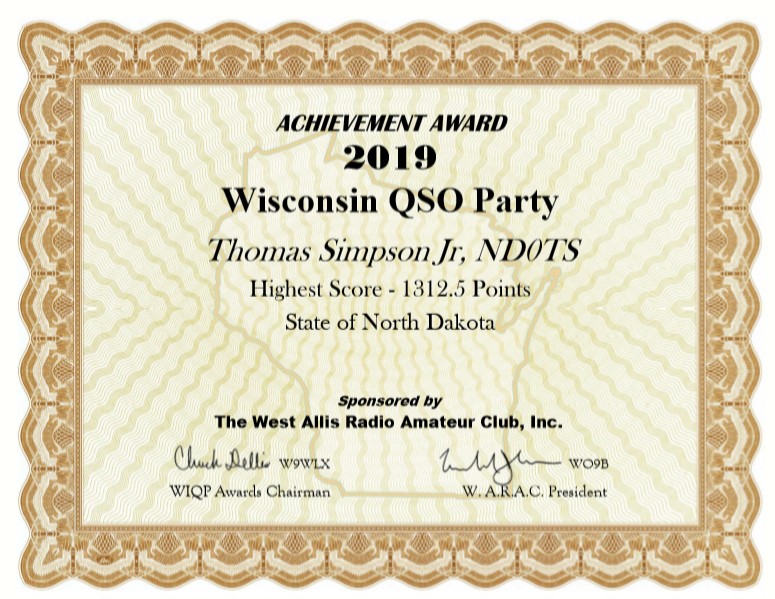
UPDATED: For not trying too hard in this QSO Party, I managed to have this sent to me on August 1, 2019:

High Score ND Section WIQP 2019

For such bad conditions on the HF bands, I was really surprised by what I was able to accomplish in the WI QSO Party, yesterday. I was able to get a total of 35 contacts in 25 different counties. Most of the contacts were on 40 meters, and a couple of them were on 80 meters.

Maybe next year, I will be able to get my brother to become licensed, so I can actually talk to him, more often. We’ll see.

During this QSO Party, I wasn’t really “trying” too hard. I did have the day off, though, so in between all the other things I was doing, I would spin the dial a bit, and see who was out there.

I also took part in the OK and ID QSO Parties, this weekend, but wasn’t able to make too many contacts in those. The conditions on Saturday were super terrible. I submitted my logs for all of them, anyway.

Next week is the Virginia and Louisiana QSO Parties. I have Saturday off of work, so I may try to get a few contacts on those.

ARRL International DX Contest – SSB

On March 2nd & 3rd, I made a few contacts in the Int. DX Contest. I got a total of 43 contacts, with a total score of 3,870. I made contacts in a total of 22 different countries on 20, 40, & 80 meters. Nothing even close to “great”, but it was fun. Even though I had to work a shift while the contest was happening, I still feel pretty good about how I did.

I’ve already submitted my log, so now we just wait and see (for a while) where I show up. The results can take months.

One interesting thing that I found, today, was a contact that I made in Belize with Victor (V31VP). He records all of his QSOs, and they get uploaded. I typed my callsign into the tool that he has on his QRZ.com bio, and was able to listen. During the exchange, he asked me if I was able to do 80 meters (and I was), so we switched bands. Unfortunately, we weren’t able to make it work on 80m.

Here’s the audio:

ND0TS de V31vp Audio
ADDED: Also made contact with him on March 30th, during the CQ WPX contest.

Air Traffic Feed Removed


Due to some trouble with equipment, I have decided to stop broadcasting the Air Traffic Feed. I will still be streaming the Amateur Radio Feed, however.

The Air Traffic Feed did not get a whole lot of listeners, anyway. Not that there was too much to listen to, either, but the decision was made to kill the feed, rather than spend any more time on trying to keep the feed up. Because I think the problem was actually from a problem with a USB sound card that was being used, I also did not want to spend any money to fix it.

If it was a more popular feed, I may have been more inclined to keep it going, but the popularity of listening to any air traffic isn’t real high.

Like I said, I am still streaming the Amateur Radio Feed. I am also still providing ADS-B data to FlightAware.


VP6D Card Arrived

Between October 23, 2018 an October 29, 2018n I was able to make six confirmed contacts with the Ducie Island DXpedition. Four FT8 contacts and two SSB contacts (on 15m & 17m) were made. Today, I received the QSL card, containing confirmation of all six of those contacts. Beautiful card.

Ducie Island QSL Card

I have a few different cards that I’m pretty proud of, and this is definitely one of them. More details about the DXpedition and a closer look at the card design can be seen here.

ISS Sent Me A Picture

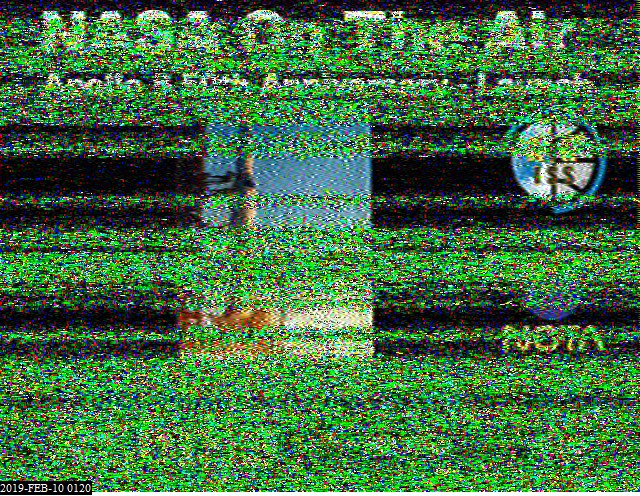
On Saturday night, the International Space Station sent me a picture. They sent the picture to a bunch of other people, too, so it wasn’t personal. The big thing about this, is that it’s the first ever SSTV image that I’ve been able to receive from the ISS.

I know that it’s not the clearest image, by far, but the ISS was about 15 degrees above the horizon, in the southwest, when I received it.

The thing that I found really strange is that I started receiving their signal about 1:30 (one minute and thirty seconds) before it came over the horizon, and continued to hear it for about 1:30 after it went back below the horizon.

I hope to get some better images, in the future. Thanks to Jason (KC0GCG), the settings on the software that I use for tracking are now correct, and I won’t be missing most of the ISS passes.

Winter Field Day Wrap Up

Well, Winter Field Day 2019 has officially come to a close. We survived, but we also came to a conclusion, and made a decision. As long as we are in North Dakota, we will never again participate in WFD as an outdoor station. We had the experience. And once is all we needed.

We got up to the island (our WFD location) at about 10AM on Saturday morning. Taking care of first things, first, we fired up the generator and the portable heater. If those two things didn’t work for, for some reason, the whole event would have been called off, for us. They fired right up, though.

The next step was to get the antennas up in the air. Using a fishing pole and a 1 oz. weight, I got it over a 40′ tree on the second shot. Pulled the fishing line, pulled the Handy Hundred, then pulled up the end-fed antenna and tied it off. Stretched out the antenna, toward the van and mounted the end about a foot or two off the ground.

We tried to get the “corkscrew” that I use to hold down the Big-Ear antenna tripod into the ground, with no luck. The frozen ground wouldn’t allow it. We ended up using a bungee cord to “attach” the tripod and mast to a 4×4 that a sign was mounted on. It worked pretty well, since nothing ended up hitting the ground.

After running all the coax and extension cord, I tested out the antennas with the analyser. I had the Big-Ear set for 20m, and it tested at 1.15:1 SWR. The end-fed tested below 2:1 on all of the bands that we’d be using, except 75m. If I remember correctly, it was at 4.3:1 at around 3.800. It was better toward the bottom of the 80m band, at 3.600, but that wasn’t where I’d be using it. I decided to try to fix that problem “later”.

Once everything was connected and running, we had about 12 minutes to spare, before the event was set to begin. I was a little surprised that it took us that long, but between and in the middle of the steps involved in the setup, we took quite a few breaks, so we could warm up.

We started making contacts, almost right away. Ran a couple pileups (the first of them was my first experience at running a pileup, which lasted about an hour). We operated on 20m, 40m, and 75m. On 75m, we were very limited, and just barely got the contacts that we needed, to count for the multiplier for the extra band. We also had a lot of (generator?) noise on 75m, but managed to get IL, TN, and WI.

In the end, we wound up with 208 SSB contacts. We didn’t work any digital or CW. At 3:43AM, I got a notification that a Blizzard Warning had been issued. It was expected to move into the area at about 9AM. I decided, at that point, that we wouldn’t be staying until 1 in the afternoon, and we would start tearing things down at dawn. We actually started tearing down at about 8:45AM, and the wind and snow was already there. Luckily, the tear-down went a lot faster than the setup, and we were off the island by 9:30AM.

Things that I’ve learned by doing Winter Field Day, this year.

  1. Never put yourself into an uncomfortable situation, if you don’t absolutely have to.
  2. Conversion vans are definitely not as insulated as they might seem.
  3. Heat rises (I actually knew this). Don’t sit on the floor.
  4. 9-10 hours is the amount of time it takes for the generator to go through a full tank of gas (it ran out at about 4AM)
  5. Whenever I get a chance to work a pileup, do it! I need the practice.
  6. “Foot Warmers” would have definitely helped.
  7. No amount of “pre-sleeping” can prevent you from getting tired.
  8. Get pictures. Sadly, this year, I did not get any pictures or video. It was the last thing on my mind, actually.

I want to send out a great big thank you to Jason Linz (ND0JL) for checking in on me via 146.52, every few hours, while he was awake. I really appreciate it!

There was one other thing that did happen, while we were up there. A county sheriff stopped up to see what we were up to. He told us that somebody had reported that it looked like somebody was living on the island. This happened just a few hours into the contest. We explained to him what we were doing, and that we had permission to be there, and everything was alright.